pre { font-family: "Major Mono Display", monospace; white-space: pre-wrap; } /* keeps wrapping
within container. Remember to use where necessary. It will wrap and respect
[newline] characters. */
Cosmology Ruler Bookmark"Dole, 2024) and Paper-and-pencil cosmological calculator (Pilipenko, 2013)
Separated by a number of years, these two authors have come up with rather similar ideas about how people can rapidly get an approximate answer to the fairly involved question of what an observed redshift means in terms of when the redshift was imposed on the light signal, and thus limits on when the light source was active.
The impression is sometimes given that a redshift can be directly recalculated into the age of the event(s) concerned (before today) and the time after the Big Bang at which these events occurred.
That's not the case. In fact you need to integrate a model of the cosmological universe, with matter density (and it's changes, and the inferred degree of deceleration ; "dark matter" and "bright" matter), the increasing amount of positive acelleration from "dark energy" in the recent parts of those events, and the Hubble constant at this time (which also changes with the inferred matter density changes). All of which is a fairly complex calculation, which no reasonable person can be expected to do in their head, on demand.
Both of these authors have come up with ideas about how to get reasonably accurate answers to such questions in real time. To those of my generation who grew up with (just) slide rules and log tables, not calculators, their solutions will be familiar, but to generations who grew up with digital computers everywhere, these analogue computers might seem a little odd. But when you're looking for an answer accurate to 2 or 3 significant figures, this sort of solution can give you that answer faster than you can enter the parameters into a calculator - assuming you have already set up the calculation method after looking up the procedure.
Nomograms are a way of recording the interrelations between several parameters which are linked by one or more equations. A simple graph (mathematical sense, not computing/ networks sense) is a relationship between two parameters, typically expressed as "x" (the independent variable) and "y" a "function of x" (or "f(x)" in a more recent notation) which you'd read off the other Cartesian axis. Or if you used polar coordinates, you'd link the parameters by a "radius" and an angle compared to the axis. Different expressions of the same underlying relationship. Well, nomograms are a way of interlinking three or more variables, in a way that can't really be done without a 3-d printer.
A nomogram is a way of linking several variables into one expression or an equation. You set out a graduated line to reperesent one variable - on which the user chooses a point for their value for that parameter (the graduation also implise a range of validity for the underlying equations, which are frequently approximate solutions). A second line (graduated differently, and not necessarily straight or parallel to the first, and also incorporating limits of validity) represents a second parameter of the equation, and typically the user then projects a straight line from those two points to intersect a third line on a graduation - which is the solution to the equation represented by the lines, thir angles, and the scales. You can generalise the system to more complex networks of lines and scales, allowing you to handle 4-parameter systems and higher.
The reader may recognise the slide rule as a particular form using several parallel lines, scales linearly, logarithmically, reciprocally, and with various trigonometrical functions. For several centuries, they were the scientist's analogue calculator of choice, for calculations accurate to 3 or possibly 4 significant figures. For greater accuracy, you'd need to use tables of functions, which would go up to 8 significant figures (by which point, they were bookshelves, not tables). My generation always carried a set of 4-figure logarithmic and trigonometrical tables with our science and maths text books.
All of which is background you can no-longer assume the present generation will understand. They need this to understand how to use either the nomograms or the "bookmarks".
Both presenters provide several ranges of z (redshift) to allow for use in the nearby universe (z less than 1), the intermediate universe (z between 1 and 30) or the very early universe (z greater than 10). There is recent "news" about a galaxy being found at redshift of 11.6 ; it's the current record holder, but it will be overtaken eventually.
I'm not going to reproduce the nomograms here. They're intended for a page printout sitting in your desk-tidy. Get the paper linked to above, and print the relevant pages. Better if you've got a laser printer and card or plastic stock to make them more hard-wearing, but they're not high tech.
The bookmark you might be able to use on-screen. It includes it's own scale, but if you "roll your own" cosmoligy thoughts, you'll probably find it a handy reference. One side covers z from 0 to 30 (the modern universe, linearly) and the other side covers z from 0.1 to 1000 (the early universe, logarithmically). In addition to the obvious z, age, and lookback time (how old the universe was when the redshift event happened), there is also a scale of angle per kiloparsec (which I think you'd use for planning observation campaigns to have a good probability of finding a good number of examples of [whatever you're hypothesising].
This image is scaled for 100dots per cm, and should fit onto a 30cm-wide printing area. Or you can scale it to fit your screen.
It has taken a decade or so for the wider world to get acquainted with (if not necessarily comfortable with) the "HDR" extensions of the JPEG format as an option for image storage and display. But JPEG was always - by decision - intended for low-quality "consumer" imaging devices - those which used an 8-bit resolution for their Red, Blue, and Green pixel values. During the whole of it's existence, there have been higher-quality sensors available, though typically not in "consumer"-grade equipment. As an example (raised in O'Reilley's ink-on-dead-tree "book" on the PNG image format, back when that was new and only intermittently supported), medical images constructed from MRI scanners and X-ray sensors routinely used 32-bit pixel resolutions (as the astronomical standard "FITS" file format is designed to use). Today, 12-bit and 14-bit precision detectors are an advertising feature in "consumer-grade" astronomical image sensors, and eventually that will work it's way into the wider imaging world.
One response to this has been the "High Definition Range" extensions to the JPEG image format. Which I stopped looking at when faced with choices over "colour gamut" and "encoding format", and I realised the field was in the middle of a format war - a minefield I did not wish to pogo-stick through. I have a depressing habit of picking the losing side in format wars (just ask my VL-bus SCSI interface card!)
Whether or not that format war is over, the more restrained field of technical imaging has a new entry for display of high-dymanic range images. From the point of view of point'n'click photographers of pretty pictures, it's probably not of much interest - because of the way it treats the low-intensity parts of the image - but for imagery with both high brightness objects (e.g., stars, or a band on stage) and low-brightness objects (e.g. nebulosity surrounding the star, or people in the audience of the band) in the same image, it presents the low brightness parts of the image with a stretched brightness while retaining the colour information in the high-brightness parts of the image.
The software is provided under the GNU General Public License (version 3 or higher if you perform any modifications). I'd expect to see it appearing in astronomy equipment driver programmes in due course, and possibly migrating out into more general image processing in due course.
For image formats, comparison images are normal. In deference to Hubble, and COSTAR, they present an image of Messier 51, the "Whirlpool Galaxy" (which Hubble imaging was itself a reference to the pen and ink drawing by William Parsons from 1845 - arguably at the start of astronomical imaging). Their first image is a recent survey image, with the R, G, and B channels displayed unweighted:
Their caption describes it as a "traditional colo[u]r image, where the background regions become black."
The centres of the two interacting galaxies are saturated - whatever pixel values are recorded in the file data, the visual image does not display the tightness of the nebular condensations. There is a hint, in the black background, of "tails" of material ejected from the galaxy's interaction.
Their caption describes this as "modified weights of the channels balance to obtain a bluer image". This is how the Hubble "first light" (and COSTAR "fixed light") images were presented. There is a strong contrast betweewn the (relatively) old stars of the galactic cores, and the relatively young populations in the spiral arms.
Given the sensitivity of human visual systems, this is the sort of presentration commonly presented to the public. But it remains the result of combining images taken through red, green and blue filters, and is not the only image that could be taken of an object, given the five filter-slots typically available in an astronomical imager. The filters chosen here correspond, reasonably well, to the sensitivity of the human eye's normal three visual pigments
The careful observer will note that the yellow "interaction tails" of the galaxies are now even less visible than in the unweighted image. That is why astronomers don't smash all their image channels into one, but keep them distinct in the FITS file format, then choose how to present them in their viewer.
The paper's caption is "gray background color image; this is the default mode of astscript-color-faint-gray. The separation between color, black, and gray regions are defined from surface brightness cuts (see text) of the G-channel (rSDSS). The use of the gray background colormap reveals diffuse low surface brightness structures that would otherwise remain unveiled."
And indeed, the "low surface brightness" of the galaxies interaction tails becomes considerably more visible. The authors also note that the "cut" between using the "colour normal" and the "inverse grey" scaling is set at a low level on the green channel.
The final image uses the normal (for astronomy) replacement of a human-compatible channel with one taken through a different astronomical narrow-band filter (this one happens to be in the red at 660 nm - which is radiation released by the Hydrogen-α energy transition, though they use it to replace the "green" human-compatible channel.
Their caption is "colo[u]r image using the Hα narrow band filter (J0660) for the intermediate (G) channel instead of rSDSS. The use of this filter reveals interesting features such as the star-forming regions that are shown in green. This also reveals some structure within the cores of the galaxies.
Another feature also intrudes - a routine problem with astronomical imaging : in the image "north-west" there is a linear feature which only appears in this channel. This is most likely a near-earth satellite which crossed the field of view while the chip was exposed through the Hα filter. Astronomical sensors are designed to be sequentiallt exposed under an external filter (R, G, B, Hα there are hundreds if not thousands in use), while consumer grade chips expose either parts of their pixel array permanently under R, G, or B filters, or alternating rows of pixels under strips of filter. Naturally, this reduces their sensitivity and pixel count by a factor of 4 - which "consumer grade" sensors can accept, but astronomers don't - hence the single-channel artefacts. Yes, this can reduce sensitivity in rapidly-changing events, but that isn't too common a problem in astronomy, and the long-established astronomical habit of taking many short-exposure shots and electronically "stacking" them mitigates this. But it is a factor astronomers take into account when planning observations. And when planning observing strategies for "Targets Of Opportunity" (TOOs) such as a gravitational wave event reported near the line of sight of a "light bucket" telescope - when the operators will slew to the TOO to take a series of pre-planned images to cover the available sensitivity and detectability gamut.
It is unlikely that this new image display format will intrude into the general public's party pictures any time soon. But astronomers, people reading astronomy papers, and possibly the surveillance industry, are likely to see it more frequently. The built in ability to customise the "cut-off" level in both channel and intensity will take some getting used to.
It strikes me - this is not unlike the visual effect called "solarisation" - which has been played with by artistic photographers since the late 19th century until the death of darkrooms in the late 1980s - and may still be in use by some artistic photographers to this day. They might like to play with this too.
A very brief thought here, in the context of the poorly-contrlled "Perigrine" spacecraft recently launched by the ULA/Vulcan mission.
wouldn't the most likely place for a leak be, in the isolation/ throttling valves from tank to motor, which would restrict the possible (plausible) thrust vectors a lot, and hence the acceleration vectors on the spacecraft?
Or are they thinking that launch vibration has fractured a piece of pipe (or a fitting) somewhere, with an unpredictable vector? In which case, venting the tank through the (more predictable vector) nozzle would at least reduce the uncontrolled vector available from the uncontrolled leak?
I don't really want to get into spacecraft design, but having had to design and build more than a few plumbing systems for [multiple] gases from [multiple] tanks to [multiple] consumers, the obvious (to me design is to have an isolation valve on each tank, leading to a manifold for each gas, then a line from each manifold to each consumer, with an isolation valve on each of those lines. Throttle valve downstream of each isolation valve.
So, anything other than a break in the tank-to-[1st isolation valve] is controllable by at least one valve. And even a leak in that section can be mitigated by using all the consumers, throttled to counterbalance the uncontrolled leak, and depressurising the tank as fast as is safe. The list of "consumers" (attitude thrusters) includes counteracting pairs, so you can ramp those to the maximum, to negligible effect on the overall directional vector.
I guess I'm either going to have to get into spacecraft design (is my design's component count too high?), or drop this. But it intrigues me, and takes me back to designing gas plumbing networks for mud logging units 36 years ago.
Update - 2024-Jan-17
Last night I noticed a couple of messages on MPML: (Minor Planets Mailing List, https://groups.io/g/mpml/topics)
From: [redacted]
Date: Mon, 15 Jan 2024 03:22:13 GMT

It seems peregrine has stopped leaking and is following a (mostly) newtonian
orbit. My slightly-over-2-hour arc suggests an impact somewhere in South America
in the morning of January 17 UTC (around 10:00 give or take a couple hours). The
orbit is currently too uncertain to even say if it will impact in the Atlantic,
Pacific, Brazil, or Peru, but it seems it's definitely somewhere around there
along a line at 10-12 degrees south.

Orbital elements:  Peregri
[SNIP Orbital elements and observations]

Re: Peregrine observations?
From: [Redacted]
Date: Mon, 15 Jan 2024 04:41:53 GMT

Hi Sam,
Good to see some more data.
Astrobotic has posted about the upcoming re-entry :
https://www.astrobotic.com/update-17-for-peregrine-mission-one/
Based on the data I've seen (combined with yours), I expect it to come in about a
day later, somewhere around latitude 10 south. It does still show a bit of odd
motion. I'm reluctant to say much about longitude until we see more data and the
fuel runs out. The uncertainty in re-entry time and longitude are linked; if
you've got a one-hour uncertainty in time, the earth gets to rotate 15 degrees

more or less. However, it shouldn't take much more data to get a precise
re-entry time/location.
Not living in the area, and having no exceptionally tall hats ... has anything happened? I'm not seeing anything on the news. The operating (and owning) company's website has an update that the lander has passed apogee (furthest point, "apo-" from Earth ("-gee") and is currently 183,000 miles from Earth. (That's a bit over a quarter million km in real money.) So I guess the second estimate for impact - Friday-ish is looking more likely. So I'll takem my extra-tall hat off then.
The Press Release doesn't estimate a landing date.
Hmmm, the [code] tag on Blogger doesn't do what I expected. Ah, I should have been using a [pre] tag pair. [pre] also being block-level, not inline. ... now I need to force line-breaks.
Update - 2024-Jan-19
On Wednesday, Astrobotic published an update describing their mission-terminating strategy combining a series of short main engine burns, and attitude adjustment to control the drift induced by the leak. This resulted an a landing ellipse between New Caledonia, Fiji and Vanuatu. (For the geographically challenged, that's in the south west Pacific.) Quoting a landing ellipse to 6σ sounds a touch optimistic for a spacecraft with an attitude-affecting leak.
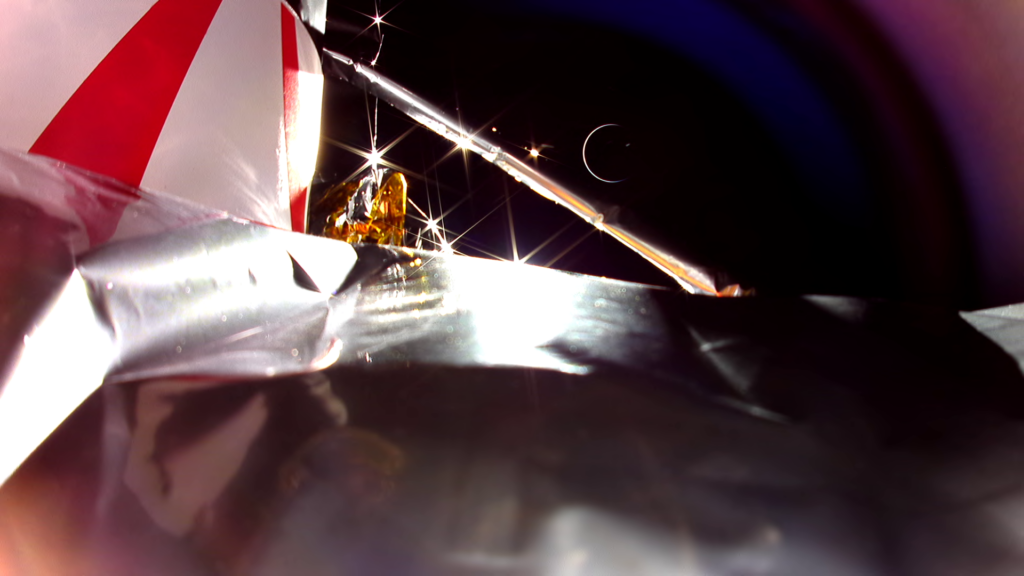
On Thursday (2024-01-18) they published another update with an image taken of their target :
(They describe some of the issues involved in planning imaging, when the spacecraft is no longer on it's planned trajectory : The first attempt to take this photo yielded an oversaturated image, with the Sun making the image too bright to see the Earth. As a result, the team precisely slewed the spacecraft to reposition the Sun to be hidden behind the thin payload deck strut just to the left of Earth, which produced the starburst effects on the vehicle and revealed the Earth’s crescent. This image is completely unaltered.) And just for entertainment, I'm trying the "rotate" option. If that works on Blogger. It did. So why did I have a note that it didn't?
But the ROTATEd DIV has a bad effect of laying out beyond the area of the post.
But will it lay out beyond these paragraphs? YES, it overprints them. I need to figure that out properly. I turned the ROTATE off. They're still flag-washing, I see. As if one's nation were anything to be proud of.
Last week I noticed a paper about the "Outcomes of Collisions between sub-Neptunes", noting that sub-Neptunes (not defined in that paper, but around 5~10×M⊕ and < 3×R⊕) have rather different collisional properties to terrestrial properties, due to their thick, gaseous atmospheres.
This paper ("Stability of Hydrides in Sub-Neptune Exoplanets with Thick Hydrogen-Rich Atmospheres") reveals another aspect of these planets, which have no analogues in the Solar system.
The question might be asked, why are these called "sub-Neptunes", not "sub-Uranuses"? After all, Uranus is less massive than Neptune (86.8 vs 102 ×1024kg). But Neptune is smaller than Uranus (R≆=49528 km vs R≅=51118 km). There is clearly an interior-compression process going on (described as a "radius cliff"), and Neptune is well inside the effect, while Uranus may or may not be. (Another "radius cliff" is thought to occur in planets larger than Jupiter, going up into the "brown dwarf" star range, though the "turn-over" radius is somewhat uncertain.)
This paper describes another effect which probably does not happen in the Solar system. At least, not outside diamond-anvil high pressure machines on Earth. The bottom of the hot hydrogen-helium atmosphere can interact with silicate minerals in the planetary core, potentially reducing some of the silicates (and their component metal ions) to release metals. Iron (present as Fe2+ in fayalite (iron-olivine) can be directly reduced to Fe0metal by interaction with the hydrogen. It is less clear if the magnesium in forsterite (magnesium olivine) can be reduced to magnesium metal, but it seems that a magnesium-iron hydride Mg2FeH6 is possible. Water (H2O) is a minor byproduct, which might accumulate at the top of the rock/ metal core, or might diffuse up to the atmosphere to freeze out at a high level.
The work is experimentally difficult, because at these temperatures (3000 K +) and pressures, the hydrogen makes the diamond cells brittle, while also making it interfere with X-ray diffraction to identify the products before they decompose on decompression. Raman spectroscopy does support the presence of Mg-H bonding though.
The new "hydride" phases, and possibly water-derived compounds in the hdyrgen could lead to a more gradual radial change in properties in these planets, which further work on Neptune might detect, in the same way that Juno's recent close orbiting of Jupiter has suggested it has a "diffuse" core-atmosphere boundary.
Sub-Neptunes are an interesting type of planet - sufficient justification in themselves to go out into the galaxy.
That initial mark isn't a diacritic "backtick", though it's often presented as such, but a distinct Hawaiʻian letter ʻokina, Unicode U+02BB, decimal 699. To a linguist, it's a "phonemic glottal stop"., and the recommendation in new work is to use the UNICODE character in preference to the apostrophe or "backtick" diacritics. The correct (HTML) orthography is (all one word) "& #x2bb ; Oumuamua".
We have 1I/ʻOumuamua from 2017, and 2I/Borisov from 2019. So why not 3I/XXX? Yet. I maintain a watching brief on the Minor Planets Mailing List (MPML, and have done since ʻOumuamua. There hasn't even been a pulse of excitement with a first-report suggesting a significantly hyperbolic trajectory, even if it were later dis-confirmed. Nada. Zip. Zilch. Which isn't suspicious - yet - but it is getting just a touch nervous-making, because ... well, how did Fermi put it? "Where is everyone?"
This sounds like it's an advance in panspermia theory. It is - but not in a good way if you think that panspermia is a useful idea. The authors use the number (1) and size of ʻOumuamua (≈ 100m) to estimate numbers for the total number of impact events, and the total collision mass, then re-work that to estimate the number of (potentially) life-bearing particles to impact Earth between it's origin and the palaeontological origin of life, and from that to it's importance on a galcatic scale. Which is basically, a bog-standard panspermia argument. And their figure : assuming 109 Earth-like planets in the Galaxy, order of 105 of them might have been seeded by panspermia. One in ten thousand. I stil think that might be a bit optimistic, but it's a lot more realistic than some of the calculations done by other panspermia fans.
Panspermia remains a practically useless idea. Given that even with panspermia, somewhere has to be the origin of life, all that panspermia does is move the question of how life originated fromhere, under conditions compatible with the history of Earth's environment toan unknown location, with an unknown history of environmental conditions. Which, as useful ideas go, is damned-all a useful idea.
I propose Optimi-Panspermia : wherever your organism proposing panspermia lives today, the planet where it's panspermia origin is had conditions like the worst planet in the system (for Earth/ Solar system, would that be Neptune, Eris, or Mercury?), and then the dispersed panspermia seeds had to get to the Earth-analogue planet, then immediately adapt to the new conditions and take over. That sounds a credible panspermia to me. And it has no more evidence for it than any other panspermia proposal.
Sorry, did I sound like a fan of panspermia for a few femtoseconds there? Sooooo misleading.
So, I'm getting a bit ... ticked off with clicking the "open in new window" option on Blogger's "add link" dialog. So ... I should be able to put ' target="_blank" ' into the CSS style header for my "a" link. No? Need to check on a different page!
OK, well I tried that - at least simplistically with 'a {target:"_blank";}' in the "style" header block . Didn't work ; page opened in the same tag.
Now, why didn't it work?
Table fidding
Do I have unstructured ways to add a comment to a table. Or would a caption do? I've got "caption-side: bottom;" set in the style sheet.
I set up a TFOOT line below the TBODY section, including a TR with COLSPAN set to occupy the whole table.
I need to find a better way to set columns to R-align - better than cell-by-cell, at least. (Stack-Overflow suggests CSS of ... Which looks workable. But it's complicated. It's easier to change the default to , because that's what I'm going to use most often. And it's mucking up updating. Or is the system just broken? This is getting horribly complex - and not working with the big table in the MOND post.
This post is probably going to grow "Contents" and sections. It's a more incremental concept.
Table Column styling
Working on the MOND table, I realised that I hate the (default) left-alignment of tables. I need to find a way to make this.column left-aligned, that.column right-aligned, and other.column centered. Something better and more manageable than setting EVERY cell.
So, what I'm wanting is something like :
H1
H2
H3
H4
1
2
3
4
2,1
2,2
2,3
2,4
3,1
3,2
3,3
3,4
4,1
4,2
4,3
4,4
F1
F2
F3
F4
But every line is of the form : ..tr....td style="text-align:right"..4,1../td....td..4,2../td.. ..td style="text-align:center"..4,3../td.. ..td style="text-align:left"..4,4../td..../tr.. which is undesirably verbose.
StackOverflow has a question that suits, and an answer:
<colgroup> <col> <col style='text-align:right'> </colgroup> <tbody> <tr [...] then "if you look at the MDN [Mozilla Developer Network] docs for <col>, you find this: "Do not try to set the text-align property on a selector giving a <col> element. Because <td> elements are not descendant of the <col> element, they won't inherit it."
So, I think I need to go down the "define my own classes" route : HTML isn't rendered by column, it's rendered by rows. That's why there ,,tr..,,/tr.. (table rows) exist, but ..tc,,../tc,, (table columns) do not. That being said, the easiest way to style a column in HTML, is by applying the same CSS class to every ..td,,../td,, in the given column. You can type in the same class to every one manually, or you could write it programmatically, via javascript or a server-side script.
So I need a worked example of defining, say, three derived classes : td.l, td.c, td.r (TableData.Left, etc). This multiply-linked solution seems specific for 4-column tables, with the 3rd column R-aligned. Ungood, I think.
What I think I'm going to try is
define an extension to td (possibly also to th, for completeness?) "td.l", which inherits td's properties but adds "text-align: left;"
similarly "td.r" and "td.c"
then set up rows of [blah] td.r td.r td.c [blah]
Which isn't as elegant as I'd like, but if the alternative is having to write whole new sets of table definitions for every instance, may be good enough.
Testing (pretty-aligned)
Right
Centre
Left
r
c c
llll
rRRRR
c CCCC
LLLll
rRR
c cCCC
lLLL
rR
c cCC
lLLll
OK - I'm getting somewhere now. I need my own class in the STYLE header (wol.td.c etc), then have my own "td class=..." in each row. Which is still 8 more characters than I'd like per element, but it's getting better. Unfortunately, while it seems to be legal, it's not having the desired effects.
Nope, still too much burying data in presentation. Just stick to the long-winded method - it's little worse.
W3.CSS approach.
https://www.w3schools.com/w3css/w3css_tables.asp has a way of "classing" centre- or left- aligned table cells. But their implementation ends up with code like "<th class="w3-right-align"> Points</th>" ... which in itself isn't so great. BUT it does only need setting in the header they assert. OK, "imply" in the first level demonstration ; I checked and it's untrue. It needs setting on every cell. No benefit.
These posts were getting really long - and therefore daunting to undertake. Maybe doing shorter, single topic posts will be easier.
New Year, New MOND data
A personal itch, being scratched in public
On a regular basis one hears assertions that "Big Science suppresses non-standard theories" - often followed up by "Free energy" schemes, Climate change scepticism, Anti-vaccination screeds and the like. It's a feature particularly of Slashdot, but more generally of the Internet. If I "did" Facebook, I'd probably cite them too. Kooks are everywhere and are vocal, and they love a "my voice is being suppressed" narrative.
So, a few months ago, I conducted an (admittedly crude) survey of a "controversial" idea in "non-standard" science using Arχiv. It was nothing complex (I searched for various terms ["Mordehai Milgrom", "MOND", "Non-Newtonian Gravity", "MOG", "Dark matter" in Arχiv's database (anywhere in article title, abstract, or body text, or figures) from Jan 01 to Dec 31 for each year, recording the counts. And now, it's time to update the numbers. They're not good reading for the conspiracy-of-suppression" theorists (well, is any reading good for them? It's not as if they like actual evidence).
Date of search
Mordehai Milgrom
MOND
Non-Newtonian Gravity
MOG
Dark matter
1991 - 2001-12-31
75
1072
735
180
43348
2001-12-31
4
38
46
16
3404
2002-12-31
2
12
13
2
693
2003-12-31
1
22
17
2
765
2004-12-31
1
12
20
2
885
2005-12-31
2
35
22
2
1005
2006-12-31
2
35
27
4
1068
2007-12-31
2
49
24
2
1179
2008-12-31
3
61
20
3
1329
2009-12-31
4
51
23
6
1635
2010-12-31
5
50
38
4
1586
2011-12-31
4
60
35
5
1643
2012-12-31
5
42
23
6
1765
2013-12-31
6
56
33
3
1802
2014-12-31
3
58
33
8
1986
2015-12-31
3
40
33
5
2123
2016-12-31
6
51
32
6
2150
2017-12-31
2
55
39
17
2239
2018-12-31
3
48
35
16
2231
2019-12-31
4
55
34
8
2419
2020-12-31
3
51
46
19
2525
2021-12-31
2
43
47
9
2651
2022-12-31
4
63
44
11
2836
2023-12-31
4
85
51
24
3429
How long is it since I made a snide comment about conspiracists and their data aversion? Too long. See table above. For those who aren't familiar with the field, "Mordehai Milgrom" is a prominent researcher in "modified gravity" ; "MOND" is a popular theory of "modified gravity" ; "MOG" is a different such theory ; "non-Newtonian Gravity" is more general term for the field ("Newtonian Gravity" being the "Big Science" conventional theory in favour of which all the other theories are being suppressed for (whatever) reason(s) ; "Dark Matter" is just there for a marker of overall theoretical activity in astronomy.
Lots of data. Would a picture help?
Much clearer. Publications in these two particular theories of non-Newtonian gravity have continued to happen at comparable rates to general astronomical activity, though the relative popularity of these two theories varies a little, "MOG" having picked up in the last few years. Mr (Professor? Probably.) Milgrom continues to publish at a fairly consistent rate - which isn't so surprising, since he's been doing so for about 40 years.
That's not the sign of a field of research that is being "suppressed", "forced underground", or even "harmful to researcher's careers". It's a sign of a relatively unpopular topic within a field. Now, "unpopular" may not be a particularly nice state to be in (anthropomorphising "theories"), but it's not a sign of effective suppression. Effective suppression is samizdat publication on midnight press runs, and the occasional publisher's head boiled in tar and spiked over the entry gates to Physics & Astronomy Departments pour encourager les autres (a short-form Voltaire-ism [Candide, ch.xxiii]; the long form is darker than many people realise.)
Having done the leg-work, I'll continue to update the data file yearly (until I get bored). If you think I should be looking at different data, that's what the "Comments" are enabled for.
FRBs - Fast Radio Bursts - remain problematic. They're at isotropic distances (outside the Galaxy, randomly distributed), very energetic, but from very small source regions (because of their rapid variability). Being a new (first detected 2007), "shiny" phenomenon, they continue to attract warranted attention. Obviously much kudos will accrue to whoever comes up with a workable solution. A big problem to such a solution is that, unlike most energetic events, at least some in this class can repeat - irregularly, and more rarely regularly.
This proposed class of solutions envisages moderately common objects interacting in a moderately unusual way. Using common objects is good for an explanation - little is known about the digestive tracts of rocking-horses, since rocking-horse shit is so rare. Ordinary horseshit on the other hand … The proposal here is to take a fairly normal black hole [an IMBH - "Intermediate-Mass Black Hole" formed by stellar collapse, massing a fistful of solar masses, not a planet mass (Primordial Black Holes, PBH - still theoretical) and not a large portion of a galaxy (SMBH - Super-Massive BLack Holes). Truely a pedestrian object - we've even detected their formation and interaction in recent years, using gravity wave observatories such as LIGO, KAGRA and VIRGO.] and throw a fairly normal White DWarf (WD, wiki link) at it ; as the BH (a few km across) tears chunks off the WD (a few thousand km across) and swallows them, the torn-up remnants may well emit radiation on time scales, frequencies, and with variability consistent with FRBs.
Even better, compact bodies (Neutron Stars, IMBHs, WDs) should fairly naturally gravitate (literally, gravitate) towards similar areas such as the centres of galaxies, globular clusters etc, increasing the likelihood of interactions.
The non-total destruction of a WD in the first encounter provides a natural mechanism for the recurrence of an FRB in a particular system. The figure that describes the model implies that the outputs are sensitively dependent on the details of a particular encounter. If any significant amount of mass transfer takes place, the details of the next encounter (and thus, a repeated FRB) are very unlikely to be identical to the previous encounter.
A particular wrinkle of this model is that the material from the accreting WD should cut across the BH's magnetic field lines, which would lead to pulsations in the accretion - as seen in FRBs. Of course, other compact body mergers would also potentially suffer similar effects, which would make deciding the cause of a particular event a matter of fairly finely balanced observations. But that was probably always going to be the case. Magnetic fields are to be expected on WDs, and NSs … but how much remains "frozen into" a BH after it's mass disappears beyond the event horizon … Good question!
When I stumble across a new word (to me) in English (or any of the other languages I study), I like to learn a bit more about it. Making this sort of note helps to fix things in my memory. It's the same logic as behind my Who Said What collection - to which I have a few new things to add. Haven't touched that since April last year, so that needs a little more fettling.
What is the origin of "kudos"?
Oh, all the way from Ancient Greek κῦδος (kûdos, “praise, renown”). I'm slightly surprised not to have guessed that myself. See also, "nous"
Wasn't kudos a big element in the Illiad? Or didn't they call that "kleios"? Sigh - another one for the re-reading list. Something about Achilles saying rude things about Ancient Greek life from the perspective of being dead. So, Odyssey, not Iliad.
One of the things non-scientists frequently don't get is that scientist are continually testing their theories by looking for things, and not finding them. This is a classic of the (not so common) publication of a negative result. (More often, they negative results are incidental remarks in the "Methods" section of a paper.)
This is perfectly simple : the data from a dozen systems observed by the TESS satellite was examined for short period, high frequency luminosity variations. They didn't find any. Which doesn't mean that these systems don't have planets - any planets could be further out (requiring longer periods of observation ; or the planet's orbital planes could not intersect with Earth ; or the periods of observation could have just been unlucky. Or, indeed, the systems may not have planets.
Negative results are a bedrock of science. They're just not sexy. If your data analysis pipeline always produces a positive result, you don't know if the result is a product of external reality, or an artefact of the processing pipeline. If you get positive results with some targets, and negative results with other targets, there probably is some difference between the two systems.
Ohhh, this sounds like fun! Beats the LHC eating the Earth any day of the week. It'd cure (for certain values of "cure") Anthropogenic Global Warming as something to worry about. And that's just the title.
Where could they be going with this? Astroseismology? Or perhaps (yet another) solution to the Solar neutrino problem? Or just blatant redneck-baiting (I have a sudden image of modifying the DREADCO "buttered toast/cat" perpetual motion machine to run off the inexhaustible indignation of rednecks about things with too-long words. Cynical? Moi?)
So, speculation aside, let's RTFP. Starting with the author list - three long, not an Avi Loeb solo lunacy special (sorry, that's being cruel ; Loeb's lunacy is generally well reasoned.), enough people there to keep somewhere in contact with reality. No names I recognise. Three institutions. None of the strong indicators of the ... fringe.
AbstractThere is probably not a black hole in the center of the sun. Despite this detail, our goal in this work to convince the reader that this question is interesting … Oh, it's one of those papers! OK, let's play!
After introducing the idea of a Hawking star (which has an asteroid-mass black hole 10-16~10-10×M☉ accreting internally in addition to normal nuclear fusion, the authors justify modelling it's evolution in some detail.
The assertion that "Despite the claimed constraints, [primordial black holes ("PBH"s, in the mass range cited above)] remain a compelling dark matter candidate for several reasons" is a bit of a surprise to me. I thought that had been excluded by OGLE, MACHO and the like, but maybe I wasn't paying close enough attention. Meh. Accepting that assertion - because it sounds a real fun idea for testing redneck PM machines - how do these authors think the presence of an accreting PBH would affect the evolution of a solar-mass star?
This sounds somewhat familiar. Did I RTFP, without making notes? Naughty Aidan! Or maybe I read one of the papers they cite - several earlier in 2023. This argument "Stars are unlikely to capture PBHs after formation. A PBH with finite velocity and falling from infinity will be accelerated up above the escape velocity and rapidly transit the star." sounds very much like an argument I made on Slashdot not-long ago. Contrary to the Physics of Star Trek ("many readers", as the authors … politesse it), the accretion of PBHs isn't an all-enveloping maw, but strongly limited by the size of the event horizon. The 10-10 M☉ PBH would have a radius of about 30000 pm while the 10-16 M☉ PBH would have a radius 0.03pm. For comparison, the (Van der Waals) radius of a hydrogen atom is about 120pm. So the number of atoms that will be absorbed at a time is in the order of zero to a few million - in the order of 10-20 kg per position. (That's my estimate. Their models, incorporate compression and gravitational radius to give a (reasonably simple) expression for the luminosity in L☉ (incorporating BH mass accretion rate (M☉/yr) and radiative efficiency (dimensionless).) Their model give accretion rates 10-9 to 10-23 M☉/yr I can't meaningfully assess the plausibility of these numbers, but a rate of 10-9 would have consumed the Sun 3.5 billion years ago. Over those accretion rate ranges, the inferred luminosities due to the BH are well below 1% of Solar luminosity - which would be within the "noise" in nuclear fusion models, given uncertainty about core metallicity and physical conditions. In short, on luminosity grounds, we can't rule out a present-day in-Sun accreting PBH.
As Telly "Kojak" Savalas used to sing, "If a picture paints a thousand data points …", so here's the graphs. Zoom in to read the axes. Their model changes behaviour (convection-limited to radiation-limited) in the middle of the MBH range considered, but still leaves Sol as not-excluded from being a Hawking star.
Section 3 of the paper examines variations on this "toy" model, including how convection pressure or radiation pressure ("Bondi" or "Eddington" domains) throttles accretion onto the BH. Two main points stand out :
The overall luminosity (and evolution over time of luminosity) are not greatly changed by the presence of the BH ;
but, the interior of the star is considerably better stirred by the BH, and this potentially could yield a measurable signal by astroseismography, and the early mixing of the core of accumulated fusion products (for a Solar mass star, essentially helium) into the outer body of the star.
The larger BH mass models cause the end of nuclear fusion at ... well, not far off the Sun's present age. Which is exactly the reason that "Hawking stars" were proposed as a "solution" to the "solar neutrino problem" in the 1970s. (The correct solution is that neutrinos have mass, and so can experience time, and so can oscillate "flavours" during their flight from Sun to neutrino telescopes on Earth. There isn't a "solar neutrino problem" now.)
The "Kippenhahn" diagrams (Figs 2 below and 4) are a nice way of summarising the evolution of stellar structure with time. I'd not met them previously. Wiki doesn't use these, but they do allow one to visualise and compare evolutionary tracks well. I suspect they'll appear at some point.
Note that the radius and luminosity vertical scales are logarithmic. The final size of a solar-mass BH is less than one-millionth of the star's radius for most of it's evolution.
Figure 4 uses a different time scale to figure 2 : decreasing time to stellar destruction, from billions of years to the last few seconds. Things happen fast at the end.
And despite my warning above about logarithmic scales, I've slipped up above where I said that overall phenomena are not greatly changed by the BH. The authors say Once in its post-main sequence phase the Hawking star becomes fully convective and slowly swells over multiple Gyr to about 10 R☉ and about 10 L☉ causing them to appear as a sub-subgiant star, joining a relatively sparse population on the HR diagram. This phase of stellar evolution is qualitatively insensitive to the initial seed mass, and lasts for multiple Gyr in our simulations.
That's somewhat smaller but longer lasting than the typical solar-mass red giant phase, so you might be able to find Hawking stars in the lower-luminosity "sub-giant" area of the Hertzsprung-Russell diagram. A moderate difference, but it might be enough to perform a pre-cut on candidate Hawking stars.
Getting into the summary, indeed the authors consider astroseismology as a potential way of detecting such stars due to the fully-convective nature of the star. Another good question : Are there X-ray transients associated with stellar destruction that are distinct from other accreting binary systems, and if so, what are the lifetimes of this transient?
It's a fun subject, and it's got lots of potential for ha-ha-but-serious blowing of minds. And Hollywood is absolutely going to love the idea of the Sun being eaten from the inside by a BH. OK, They'll have to invent some pseudo-physics for James Tiberias Hulk and Spock Man to save the universe (well, Earth) with. But fun nonetheless.
Who doesn't love a bit of random destructiveness at a suitably large range? In the other carriageway for a little car bump ; in a different part of the galaxy for slightly bigger bangs, as discussed here ; in a galaxy far, far away for whatever causes Gamma Ray Bursts. This is medium-scale rubber-necking.
The recently published 6-planet system in (I can still remember the "phone number"!) the HD 110067 system (which has also been reported to be a widely-spaced multiple star) is very much the sort of system they're talking about. Though I don't think they mention it by name.
Why does this class (size range) of planets deserve separate treatment (from "rocky" planets, "small bodies", "Jupiters" (hot or not) and bigger bodies? FTFAbstract : For sub-Neptunes, the dominant type of observed exoplanets, the planetary mass is concentrated in a rocky core, but the volume is dominated by a low-density gaseous envelope. For these, using the traditional sticky-sphere assumption is questionable. While they can get mergers (for certain ranges of energy and impact factor), loss of large amounts of atmosphere are also a common outcome (which doesn't really have an analogue in smaller collisions, and complete disruption of both impactors is also common. That latter might suggest that growth of planets rather stalls in this mass-range, leading to the sub-Neptune group being the commonest type of planet discovered. (Though how much of that is a discoverability issue remains open.)
Rather than the more common computational strategy of using an array of different test objects, they only consider one pair of planets (masses m1,2 = 4.51,7.55 M⊕, radii r1,2 = 3.56,3.69 R⊕) around a sun-like star. But they inspect the parameter space by putting the two bodies in an unstable pair of orbits, then letting them evolve. With computational noise, that generates a … realistic (hmmm - questionable?) range of impact conditions for investigation. Unusual strategy, but I can see reasons for using it.
Those "test planets" are 9.99 % and 15.0 % of the Earth's density. I guess those numbers aren't so random as they look. 3:2 ratio of masses too. I wonder if they "select" from the variety of impacts they get : yes, they select on vimpact÷vescape. And high values of vimpact÷vescape lead to complete disruption of both planets - now that shouldn't be a surprise.
Here's another non-surprise. The star would get in the way of studying the interactions of the planets, so We treat the host star as a non-interacting point-mass particle, exerting only gravitational influence over the planets. If a particle approaches within one solar radius of the star, it is accreted into the star, conserving mass and linear momentum. Again, perfectly reasonable, but it's fun to see people saying it. hubris, thy name is throwing planets at each other for a living. Must make for fun dinner parties. Or am I channelling Rick'n'Morty from the telly? (episode: "The ABCs of Beth" - hey, the Krootabulan male has an appropriate three nipples!).
Hmmm, this description of the planets is … not over-detailed : We assume that 15% of the total
planet mass is in the H-He envelope, and the rest is in the iron core and rocky mantle in 30 : 70 ratio. We truncate the planet profile at a negligible density of 0.01g cm−3 and consider this as the planet’s surface. It's not wildly different from "Earth". But using an Equation of State (EOS) for a granite to describe a mantle? Are there no suitable peridotite EOSs?
More hubris in the planet-smashing community : We tackle [problem] by utilizing StarSmasher’s ability to handle unequal mass particles. yes, that is the name of one of their software packages, which they use for smashing stars together. But it's obviously a game's name. Sick! They're sick, I tell you!
OK, I learn something new every day. Today is the use of a CGS pressure unit, the "barye" (symbol "Ba"). Which is 0.1 Pascal (SI), a millionth of a bar (non-SI). That's unhelpfully obscure. I read quite a bit of astronomical work (and specifically, planetary science), and I had to look that up. Not a helpful choice of units - but probably also in "progress one funeral at a time" territory. The pressure and density profiles in Fig 2 are otherwise useful - yes, these are very different planets to Earth ("terrestrial" planets) and Jupiter (gas giants, see for example, the Juno data about Jupiter in Figure 1 of this Icarus paper of 2022). At the limit, these sub-Neptune models start to approach the "dilute core" models for Jupiter, but that theory (and the disk instability formation model underlying it) are moving into the realm of theory, not (Solar system) reality.
All that comment on the work of the paper, and I finally get to the Results. They're not too surprising : they get three types of outcome : "Hit and Run" (the most common ; two planets at the end ; small mass transfer, mostly in the atmosphere component) ; "Merger" (one planet, and some debris) ; and "Catastrophic" (no large fragments of either planet result ; high mutual velocity compared to escape velocity). The boundaries between "Hit and Run" and "Merger" are rather blurred, as different workers seem to use different degrees of mass loss (to the star ; to distribution away from the "inner" planetary system) to classify interactions. "Mergers" can lose up to 40% of the two planet's mass, and "Hit and Runs" can lose up to 25% of the system's mass. Which is not exactly a trivial consequence. "Mergers" that loses 40% of the mass of the planets could largely "stall" planetary growth at the "sub-Neptune stage" without there being a meaningful "reason" for sub-Neptunes to be favoured over (say) Jupiters. Which is rather less significant than the raw observational data might seem to suggest.
On a regular basis one hears assertions that "Big Science suppresses non-standard theories" - often followed up by "Free energy" schemes, Climate change scepticism, Anti-vaccination screeds and the like. It's a feature particularly of Slashdot, but more generally of the Internet. If I "did" Facebook, I'd probably cite them too. Kooks are everywhere and are vocal, and they love a "my voice is being suppressed" narrative.
So, a few months ago, I conducted an (admittedly crude) survey of a "controversial" idea in "non-standard" science using Arχve. It was nothing complex (I searched for various terms ["Mordehai Milgrom", "MOND", "Non-Newtonian Gravity", "MOG", "Dark matter" in Arχve's database (anywhere in article title, abstract, or body text, or figures) from Jan 01 to Dec 31 for each year, recording the counts. And now, it's time to update the numbers. They're not good reading for the conspiracy-of-suppression" theorists (well, is any reading good for them? It's not as if they like actual evidence).
Date of search
Mordehai Milgrom
MOND
Non-Newtonian Gravity
MOG
Dark matter
1991 - 2001-12-31
75
1072
735
180
43348
2001-12-31
4
38
46
16
3404
2002-12-31
2
12
13
2
693
2003-12-31
1
22
17
2
765
2004-12-31
1
12
20
2
885
2005-12-31
2
35
22
2
1005
2006-12-31
2
35
27
4
1068
2007-12-31
2
49
24
2
1179
2008-12-31
3
61
20
3
1329
2009-12-31
4
51
23
6
1635
2010-12-31
5
50
38
4
1586
2011-12-31
4
60
35
5
1643
2012-12-31
5
42
23
6
1765
2013-12-31
6
56
33
3
1802
2014-12-31
3
58
33
8
1986
2015-12-31
3
40
33
5
2123
2016-12-31
6
51
32
6
2150
2017-12-31
2
55
39
17
2239
2018-12-31
3
48
35
16
2231
2019-12-31
4
55
34
8
2419
2020-12-31
3
51
46
19
2525
2021-12-31
2
43
47
9
2651
2022-12-31
4
63
44
11
2836
2023-12-31
4
85
51
24
3429
How long is it since I made a snide comment about conspiracists and their data aversion? Too long. See table above. For those who aren't familiar with the field, "Mordehai Milgrom" is a prominent researcher in "modified gravity" ; "MOND" is a popular theory of "modified gravity" ; "MOG" is a different such theory ; "non-Newtonian Gravity" is more general term for the field ("Newtonian Gravity" being the "Big Science" conventional theory in favour of which all the other theories are being suppressed for (whatever) reason(s) ; "Dark Matter" is just there for a marker of overall theoretical activity in astronomy.
Lots of data. Would a picture help?
Much clearer. Publications in these two particular theories of non-Newtonian gravity have continued to happen at comparable rates to general astronomical activity, though the relative popularity of these two theories varies a little, "MOG" having picked up in the last few years. Mr (Professor? Probably.) Milgrom continues to publish at a fairly consistent rate - which isn't so surprising, since he's been doing so for about 40 years.
That's not the sign of a field of research that is being "suppressed", "forced underground", or even "harmful to researcher's careers". It's a sign of a relatively unpopular topic within a field. Now, "unpopular" may not be a particularly nice state to be in (anthropomorphising "theories"), but it's not a sign of effective suppression. Effective suppression is samizdat publication on midnight press runs, and the occasional publisher's head boiled in tar and spiked over the entry gates to Physics & Astronomy Departments pour encourager les autres (a short-form Voltaire-ism [Candide, ch.xxiii]; the long form is darker than many people realise.)
Having done the leg-work, I'll continue to update the data file yearly (until I get bored). If you think I should be looking at different data, that's what the "Comments" are enabled for.
What caught my attention about this? Well, "influence on Solar System bodies" means something really close, but the HD catalogue is of relatively bright stars. Just from the number, I'd think - that is likely a star about 7th magnitude (to 6th magnitude - naked eye limit - there are about 6000 stars). So ... that's not a normal combination. "Attention grabbing", as a newspaper editor might say (followed by Shome mishtake, shurley? from Lord Gnome).
The abstract is more informative : In the latest Gaia third data release one can find extremely small proper motion components for the star HD 7977. This, together with the radial velocity measurement lead to the conclusion that this star passed very close to the Sun in the recent past. Ohhh, right. That's a fun one. See my choice of title. Next question - does the WWW (Wonderful World of Wiki) know about this? Yes. No significant additions needed there.
This paper is about how much effect the passage of such a star (see 'properties' table) has on Solar system bodies, and particularly Long Period Comets (LPCs, because they're relatively loosly bound to the Sun). It's not immediately obvious that passing a Solar mass through the Solar system would have a big effect - the star is currently 250 LY away making for an average speed of 1 LY every 11,200 years. 1 LY is a reasonable approximation to the outer edge of the Oort cloud of LPCs. (Buried in the paper, they imply their "edge" to the oort cloud is at 0.5 pc, which is 1.6 LY. Meh.) More correctly, I should be talking about the sun's Hill sphere. But that's more complicated (partly because for a small "miss distance", the Hill sphere becomes very small. Guess I'd better RTFP.
My inference of brightness from the low HD-number is fair. SIMBAD has 13 identifiers for it, only 3 from GAIA. It's brightness is (as normal) variable across different colour bands, from 9.63 in the B band to 8.89 in the G band. It is situated in Cassiopeia, so is circumpolar from most of Europe and North America. The record has astrometry as far back as 1840 - pre-photographic - which cannot be ignored. The GAIA data releases have a low uncertainty, but they assume the star is a single body. If it is multiple bodies whose images overlap, differently during different observations, then the positional uncertainty could be much higher than the relatively short time span of GAIA observations can detect. Because of this, and the star's brightness, visual and older photographic data must be considered too. (Table 3) Argelander catalogued the star in 1842 and 1875 - at different declinations, from different locations (Finland and Bonn, when he was compiling the Bonner Durchmusterung where it is catalogued as BD +61 250. Further observations were recorded in 1903 (whose plates were re-measured by the author team),the 1920s, 1930s, 1940s and 1950s, then a hiatus until the 1980s, 1990s, 2000s and then the various satellite data. None of the data shows the star to definitely be a multiple star, but the multiplicity hypothesis cannot be ruled out either (remember - about half of all stars are found in multiple systems, so at least one in three of observed stars are probably multiple. No companion has been located on the sky, but a barely resolvable component remains possible.
All this positional work gives revised, and larger, uncertainties on the star's proper motions (in Right Ascension and in Declination), which project back to how closely the star's path would have intersected with the Sun's position. 5 of their 27 position estimates had to be discarded due to inconsistencies in the resultant dataset - which isn't terrible, but doesn't reduce the final uncertainty in the data. Putting it all together, they get a nominal closest approach between HD 7977 and the Sun to be equal 0.011 pc (∼2,300 au) during its passage 2.47 Myr ago, but with uncertainties on all factors (±0.024 pc in distance and ±0.03 Myr (30,000 yr, about 3 times the transit period of the star through the Oort cloud).
The issues identified here were also applied to the rest of the GAIA set of stars which appeared to have approached within a parsec of the Sun, identifying another two possible encounters. One of these, "P0533" (in the Stellar Potential Perturbers Database - "StePPeD") was quite close (0.223 pc) at 3.19 Myr ago, but weighs only an estimated 0.87 M☉. But the other new discovery (or identification really - it too was catalogued in the 1920s) "P3509" approached to (nominally) 0.402 pc at 3.94 Myr ago, but is estimated to weigh 3.50 M☉. That is much more likely to have had a noticeable effect.
Having established several new potential close-approaches, and some factors to consider in searching for more, the authors then move on to consider the effects of such a close encounter. Far and away most likely is that the star will pass close to a long-period comet, particularly at it's aphelion when it is moving most slowly and so is exposed to the passing star's gravity for the longest period of time. This could lead to ejection from the Soalr system (which we then wouldn't see) or it could deflect the comet to a closer aphelion). To further reduce the dataset, they only considered comets observed with a good orbit (well, obviously) and those with perihelion outside 3.5 AU (keeping them away from interactions with most of the asteroid belt and inner planets, but not avoiding Jupiter). Their interpretation is that close stellar approaches do increase, appreciably (maybe 40%, for the HD7977 close approach, alone). Several of their detailed study comets show major changes in orbital parameters due to interactions with these stars. But to me, the important point is that they're seeing multiple interactions within the period of one orbit - up to 4 or 5 times in one orbit. So, these interactions become the matter of noise in the record, not a cataclysmic single event. And we know form the geological record that - while major impacts do happen, life as a whole can handle them. It's a deal, but not a big deal.
Do these close encounters affect the planet's orbits?
The most likely planet to be affected is Neptune. It's furthes from the Sun, furthest from Jupiter, and (potentially) closest to the perturbing body. And, yes, it can be disrupted, but not very often. And we already know that it hasn't been. So ... what's going on? Is there an error in the analysis, or in interpretation of positional data (and hence closest approaches, resulting from unidentified multiple stars. And that reminds me that we're still not sure that the Sun is a single star.
I've got a headache now. The issues in astrometry are quite clearly explained. The results of the close aproaches are much harder to interpret. But we know - from the geological record - that bad things don't happen often enough to be important. Time for a break.
Totally by coincidence, I'm watching Anthony Hopkins eating people's faces as "Hannibal Lecter". Was the posing of a skinned+gutted cop with Red/White/Blue bunting in a "blood eagle" some way of prodding at American sensibilities? Are they really so sensitive about .. those three colours? The colours of who-knows how many flags around the world? In the words of Marvin (The Paranoid Philosopher Android ; the "clearest thinker I ever knew" (DentArthurDent), "It gives me a headache to think down to that level."
Truely a great comedy - for how it exposes people's irrationality.
So, I'm getting a bit ... ticked off with clicking the "open in new window" option on Blogger's "add link" dialog. So ... I should be able to put ' target="_blank" ' into the CSS style header for my "a" link. No? Need to check on a different page!
OK, well I tried that - at least simplistically with 'a {target:"_blank";}' in the "style" header block . Didn't work ; page opened in the same tag.
Now, why didn't it work?
Table fidding
Do I have unstructures ways to add a comment to a table. Or would a caption do? I've got "caption-side: bottom;" set in the style sheet.
I set up a TFOOT line below the TBODY section, including a TR with COLSPAN set to occupy the whole table.
I need to find a better way to set columns to R-align - better than cell-by-cell, at least. (Stack-Overflow suggests CSS of ... Which looks workable. But it's complicated. It's easier to change the default to , because that's what I'm going to use most often. And it's mucking up updating. Or is the system just broken? This is getting horribly complex - and not working.
One of the consequences of having something repeat is that you start to ask "how often does it repeat?". "is the rate changing", "is the rate not changing?", "is the rate noisy?", "is the rate not noisy?". As I used to say to my trainees, with a datum, you've got a datum ; with two data points, you've got a difference ; but with three data points, you can start to do meaningful sadistics." These authors agree. FTFAbstract :
In this work, we analyze the statistics of waiting time between bursts of three repeating FRBs from four data sets.
So, about the sparsest dataset you can hope to treat the numbers with sadistics and get something meaningful out. One of the most significant discoveries in the study of FRBs is the identification of a repeating FRB known as FRB 121102. Wait a minute - that has been repeatiung for a few years now. So how many events does it's sequence have? Quite a bit more data than the sparse set I just described. Sounds like a job for Wiki! Which gives me the 2012-11-02 first-identified burst, ten more identified from archived radio data in 2015. The next batch report was in December 2016 (one having been received on 13 November 2015, four on 19 November 2015, and one on 8 December 2015) - so that's giving a nice range of intervals already. On 26 August 2017, astronomers using data from the Green Bank Telescope detected 15 additional repeating FRBs coming from FRB 121102 More grist. Active little begger, this one! This also sounds like a well-planned observation campaign, because they wrung a lot more information from the data - polarization, and rotation of polarization. Hundreds more burst in 2018 through 2019, with a noticeable periodicity near 157 days. (This is coming back to me. The process of writing notes helps fix things in long-term memory. As any teacher could tell you.) So the data situation is by no means as dire as the introduction made out. Wiki isn't very good at separating the repeaters from the non-repeaters, and the data pile gets a bit confusing. Let's get back to the paper.
Since the identification of the first FRB in 2007, the tally of discovered FRBs has increased to over 700, with more than 60 shown repeating burst phenomena. Right, so the data situation is, indeed, far less serious than I'd inferred from the introduction. People are debating if all FRBs are repeating, but we don't happen to have the right telescope in the right mode and orientation at the right time. I'm sure some people are incorporating testing that into other observation programmes.
Working into the paper, the total data available is actually quite a lot :
FRB data
Source FRB
Burst (count)
Observed (hrs)
Observing run (d)
121102
1652
59.5
47
20201124A(A)
1863
82
54
20220912A
1076
8.67
55
20201124A(B)
881
~4
4
Totals
5472
154.17
160
Two distinct sequences of events at the location "20201124A" were recorded, designated here 'A' and 'B'. The event "20201124A" occurred on that date, at a location on the sky ; it repeated at other dates and times.
The relative abundance of data, spread across a range of locations, fluences (brightnesses) allows these scientists to pick out a scaling law where short intervals are followed by short intervals, and long intervals are followed by long intervals. This is decidedly different to the behaviour of a Poisson process - where the length of intervals is independent of previous behaviour.
This behaviour isn't unique to FRBs. Clustering of events following similar laws is also seen in earthquakes and solar flares (both events where there is a continuous accumulation of strain (mechanical, magnetic) leading to an event that reduces that strain. Which suggests models for what is happening in an FRB. Contrary to intuitive view, the probability of next burst occurring does not increase with the time t elapsed since the last burst; rather, it decreases and the expected residual time to the next burst ̂λ is also increased. […]Furthermore, the fluence of the subsequent burst does not increase with the waiting time but appears to be independent of it. Now that last part is really contra-intuitive. By no means unique (in thinking about earthquakes, a model of the fault "annealing" and getting stronger with time is often used. Of course, being buried in rock renowned for transparency, it is probably harder to see what is happening in an earthquake fracture zone than in something half-way across the universe (FRBs with high apparent redshift have been detected).
This work is one of the first I've seen (which doesn't say much) that uses a lot of data from the new Chinese Five-hundred-metre Aperture Spherical Telescope (FAST), to which I assume the authors are attached.
This is why I use Iarxiv : Regardless of the sequence that papers were submitted to Arχiv on the day in question, this one got filtered to the top of my pile by Iarxiv, on the basis that I'd followed links to other papers with similar keywords in the past - clearly a topic I'm interested in. Whatever their scoring algorithm, this one came in at a value of 0.65, when few papers make it above 0.4. If I continued to use the daily email (of all papers, in certain categories in Arχiv), then the papers would be ordered in sequence of submission (or acceptance - yes, Arχiv does do some refereeing of it's submissions). I may block most scripts on most sites, and block cross-site scripting to the likes of doubleclick and facebook, and auto-block a large list of advertising sites ; that's because I don't like advertisers distracting me, not because I don't understand what they're doing. If they do something of value to me, I might choose to accept their services. But if they don't provide anything of value to me, why should I provide them with information they can sell. But that's politics, not science. (Mentioning Iarxiv's use of "keywords", I guess I'd better add a few here.)
"Giant Impacts" were a bit of a shock when the concept was spreading in the 1970s. The appaling power of even regular impacts (Meteor/ Barringer Crater ; then Chicxulub - the "dinosaur killer") was disturbing to people who were getting somewhat used to the idea of thermonuclear annihilation (I grew up within cycling distance of a foreign nuclear base on "Aircraft Carrier 1". Imminent death for other people's gain changes your thinking.)
But the concept of a "Giant Impact" (the capitals seem appropriate) is inherent in the model of planet formation by growth of smaller bodies aggregating onto each other. "Aggregation" means either a relatively small body impacting a relatively large body (e.g. Chicxulub, regardless of it's effects of extinguishing ammonites, and some of the dinosaurs), or two nearly-equal size bodies impacting. Which latter is a "Giant Impact". And hence the interest in the "Giant" part of the impact range.
Worse - if you find the idea discomforting - is that most of the growth in size of planetesimals to become planets, comes from the mutual impact of similar-size bodies. If two bodies collide, one ten times the diameter of the other, then their ratio of masses is approximately 1000:1. So, to get the growth effect of a giant impact (with 50% mass loss) on the larger body, you need O(500) ("order of 500" of the smaller impacts? (Yes, the efficiency of accretion is an important factor. At least, if you're in the business of building planets.)
OK, enough general maundering. You can probably get much the same from Wiki (but see my caveat). Let's see what the "Annual Review of Earth and Planetary Sciences" has to say on the matter. This year.
First, RTFAbstract : their first substantive point is that the Giant Impact (hereafter, "GI") that formed the Moon is probably the one we have most information about. We have samples definitely from the resultant debris (a programme called Apollo, IIRC) ; we have more arguable samples from the target body (Earth has active geology ; it's accessible surface is almost certainly different to the surface - and depths - during the GI) ; we even know where the target body and debris are now, probably 4+ Gyr later (though they may have moved, significantly, in that time interval). Contenders for the second best known example might be the Pluto-Charon forming impact, or the (suggested) GI that gave Mars it's hemispheric dichotomy. (My caveat : the Wiki article is about specifically the "Moon"-forming impact, while it's title suggests it's more general application. Somewhere below I'll detail my compilation of data about which Solar system bodies have evidence suggesting a late-stage GI in their formation, but the total is that about 6 of the 11 largest bodies in the Solar system have GI-suggestive features.
Section 1 - Introduction
In the "Introduction" they introduce alternative terminology, and point at an interesting wrinkle : the common monikers are pairwise accretion and similar-sized collisions; aside from gas giants, there is little distinction between the terms similar size and similar mass. The wrinkle is that, because of internal compression, the mass of gas giants is complexly related to their mass. Contrary to intuition, as mass increases through Saturn size to Jupiter size, the radius increases, but somewhere not far above Jupiter mass, internal compression becomes more important and as the mass increases, the radius decreases. This continues (probably, by modelling) until about 80 Jupiter masses, when the core reaches the point of thermonuclear ignition. (What happens with temporary deuterium-powered fusion is an uncertain question.) That's an interesting wrinkle, but not really important to GI. The paper discussed above, about the impact of "sub-Neptunes" on each other is also very relevant in this - as you move from "rocky" planets ("planetesimals", "protoplanets", or even "small bodies") into the realm of "ice-giants" then "gas giants" the changing density profile through the bodies does result in changing impact behaviour.
Figure 1 : Pretty picture. For certain values of "pretty", probably best involving a very good telescope. Credit Andrew Gonzalez
The introduction mentions the important role of the (mutual) impact velocity (and hence kinetic energy and angular momentum) in analysing these particular impacts. And, as anyone who did ball-bearing on ball-bearing calculations at school (or played snooker after school), they're essential in rigid body collisions too. In planetary calculations, the velocities are generally normalised compared to the (mutual) escape velocity of the impacting bodies, vesc.
It is probably worth noting that most computational work in this area (all? possibly ; I can't remember hearing of another technique) is done with "smoothed particle hydrodynamics" (SPH) where the bodies are treated as collections of (relatively small) particles which have their own mass, volume, density, "stickiness", rigidity and gravity and they are thrown about in the computational arena until they either adhere to each other, or go beyond the computational limits of the modle. Mathematically simple (literally, you probably did this at school), but involving millions or billions of calculations per step of the model. Big number crunching like this used to need supercomputers ; modern recreational graphics hardware (GPUs) makes it a much cheaper task. I wonder if someone has tried to farm such work out to BOINC?
Giant impacts can result in many outcomes (see the "sub-Neptunes" paper discussed above), with impact factor (offset from a head-on collision) and collision velocity (comapred to vesc) as major determinants). The impacting bodies can merge almost fully (Venus, Uranus?), merge with debris (Earth-Moon, Pluto-Charon?), or be completely disrupted (myriads of asteroid belt examples?). Part of one body can be lost, and the other either lost or disrupted (Mercury, and it's missing mantle?). And the largest range of outcomes is classified as "hit and run", which results in some loss from both impactors, but both surviving (this is not much help when you're trying to build a larger planet).
Section 1 of the review discusses these ranges of outcomes, and the methematical underpinnings of the analyses. It's a review.
Section 2 - modelling
Section 2 discusses aspects of modelling. One thing that is reported that hasn't been much discussed previously is that if the impact velocity is higher than the speed of sound in the materials, thne the collision is supersonic, and understanding these events demands accurate shock equations of state - which is potentially amenable to laboratory investigation, involving big guns and exciting booms. Figure 4 puts this into context of impactor size and material - collisions involving Earth-size bodies are probably supersonic for forsterite (an olivine mineral, an approximation to mantle materials) but Mars or Mercury-size impactors are probably subsonic for forsterite, but supersonic for solid or liquid water. Asteroid belt size bodies, on the other hand are probably subsonic even for bodies rich in liquid water. That is news (to me).
This last is more relevant as collisions in the early Solar system are likely to have involved bodies that are relatively warm (compared to today) due to the presence (in the early Solar system ; this may not be a common situation) of short-lived radioisotopes such as 26Al from a recent nearby supernova. The isotopic signatures of this can be detected in Solar system specimens, but detecting such evidence remotely would be ... "challenging".
The presence of liquid water and the potential melting of solid water is important because it is relatively effective at converting impact energy to thermal energy. But it doesn't dispose of angular momentum. That makes the modelling of the impacts of particles in "SPH" further from inelastic "ball-bearings" and into the realm of soft, deformable bodies - needing a lot more computational grunt in your simulation. 20 years ago it was a problem that had to be ignored ; these decades, it's a problem that has to be faced - billion-fold.
Section 3 - Consequences
1- Well, duh, that's going to have consequences. Of course.
The contra-implication is that planets didn't form by myriads of "small" accretions. Which is something that you could reasonably argue for one, or a few, planets. But at some point it has to be faced for medium-size planet(-esimals). But, at some point, even if there were a mystical way of avoiding similar-size bodies from interacting, you'd end up with some "similar-size" bodies interacting. The issue can't be avoided.
Giant impacts in pebble accretion theory. Yes, certainly "pebbles" will interact, and accrete. The effects of within-particle cohesion and viscosity will lead to larger particles, eventually resulting in the similar-size interactions which are the subject.
Frankly, "pebble accretion" isn't a problem.
The unavoidably stochastic nature of "hierarchical growth" also, naturally, leads to a considerable diversity of outcomes from each collision, and each chain of collisions.
It may be disturbing to some that seemingly simple interactions following well-understood laws of physics can lead to uncertain outcomes. But that is the case. The word "seemingly" is important in that description.
Section 4 - Conclusions
Giant impacts are ubiquitous. As planetary systems evolve, the proportion of protoplanetary embryos (considered as approximately Moon-mass bodies, grown by pebble accretion or some other process, including smaller-scale GI) rapidly decreases until effectively no non-GI bodies are left. Bodies that are the products of a chain of ten, twenty or more GI are intrinsically possible. Reduction of numbers of planetary bodies is the only thing that stops this process.
In this context a "fractionally large moon" is one, like Earth's Moon, which is a significant fraction of the planet's size (3474.2 vs 12742 km diameter, 0.272 or 1/3.66 ratio ; 0.0202 oe 1/49 in volume).
THey start with an assertion I've always treated with considerable suspicion : that The Moon stabilizes the Earth’s spin axis at least by several degrees and contributes to Earth’s stable climate.Well, since Mars - without that "stabilisation" has obliquity (rotation axis to orbital plane angle) rate of change which can reach a degree per 10 kyr - which is should be within the capability of life to evolve (or migrate) around. As for how "necessary" it is ... well both Venus and Mercury are thought to be stabilised by interaction with the Sun. So how "necessary" is the Moon to life on Earth? (While checking my prejudices on this, I notice that significant Earth-obliquity: Moon resonances may occur in the next few Gyr, which also challenges just how important a "large Moon" is to life on Earth. (reference : Ward, W.R. (1982). "Comments on the Long-Term Stability of the Earth's Obliquity". Icarus. 50: 444 - 448 doi:10.1016/0019-1035(82)90134-8. ; It's open access, so go get it.)
Sorry, but I'm used to SF authors asserting that "The Moon is necessary for life to have evolved on Earth" or even that a "freakishly large Moon is essential to the development of life anywhere". Well, that may be good enough for an SF author, but I am far from convinced that it's a securely-founded opinion. Sorry - pet rant.
The gist of this work is that vapour rich planets involved in a giant impact (GI, see previous discussion) will produce a vapour-rich debris disk, within which many of the debris fragments from the collision will experience gas drag and re-accrete to the primary rather than forming a "fractionally large" satelite. To get a "fractionally large" satellite, you need a relatively large impact energy or low-Vapour Mass Fraction (VMF) impactors.
Which is well enough. There probably isn't enough information to say exactly what happened in the formation of the Solar system - but we do know that (1) it happened, and (2) models that can describe it happening are reasonably easy to construct.
 This image is scaled for 100dots per cm, and should fit onto a 30cm-wide printing area. Or you can scale it to fit your screen.
![M51 traditional colo[u]r image, where the background regions become black](https://blogger.googleusercontent.com/img/b/R29vZ2xl/AVvXsEjKCEGZSl1hL9H5ryGbV2kDZrtdD1GNDKI8hiURR7j0FdcrgfGCO-ALT6CFgLxo9vVVxy6UwQS75nH61jORPuLhyDjN-BBrK6MI7yh53L5Qawna7cVTcdJa6PzgiIG0wFFH6YYrBLfYLhjSj2ktA7h3we2B7NtQCTBTatHgsb_6dNSevLd-PSYAsw/s1600/GNUASTRO%20Fig1a%20RGB-unweighted.jpg)